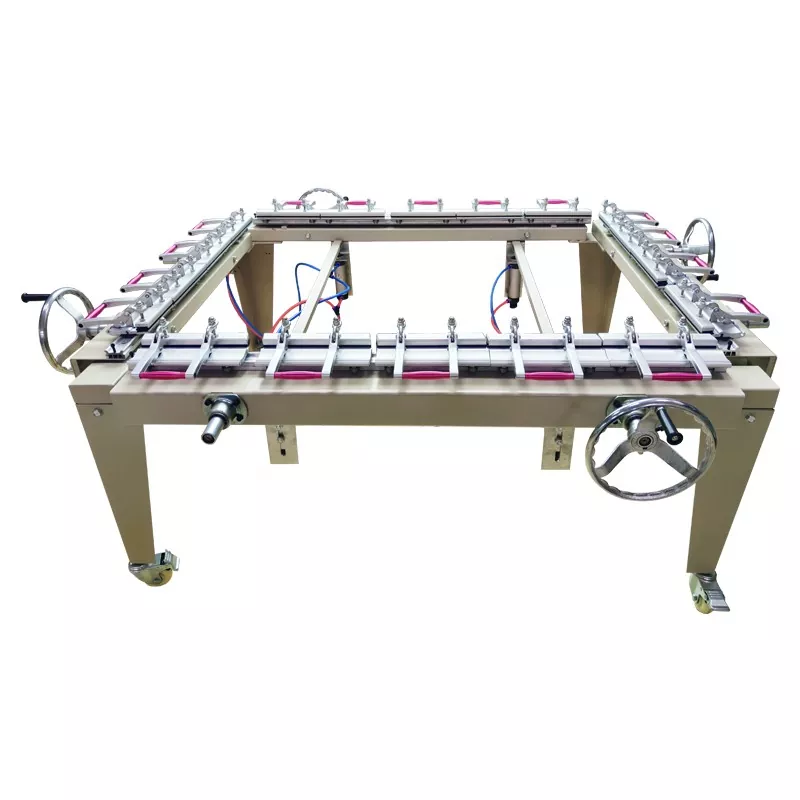
In screen printing, the mesh count, wire diameter, weaving method, and material of the screen directly affect the tension of the stretched screen. During stretching, the tension is measured based on these parameters. When measuring tension, the point being tested should be 10 cm away from the inner edge of the screen frame; otherwise, the measured tension will be inaccurate. The maximum tension values achievable for each mesh of SEFEN PET 1000 are shown in the table below. The maximum tension values indicated in the table represent specific screen strength, i.e., the maximum tensile force that various mesh counts and wire diameters can withstand and rebound. If the tension values given in the table are exceeded, the wires will lose their elasticity and undergo plastic deformation, which should be taken seriously during stretching. The unit of tension is Newtons per centimeter (N/CM), and it can be measured using a Newton tension meter. This tension meter can measure both warp and weft tension. The warp tension of the screen is the tension along the entire winding direction of the screen roll, i.e., the tension along the edge; the weft tension is the tension along the width of the screen. As can be seen from the tension table, the tension of screens made from the same material with different wire diameters and mesh counts will vary. Even screens with the same mesh count will have different tensions depending on the wire diameter, because tensile strength is directly proportional to wire diameter. For example, if wire A's radius is twice that of wire B, then the tensile strength of wire A is four times that of wire B. The tension values in the table are effective for high-strength screen frames with side lengths of approximately 1 meter or less. For screen frames with edge lengths of 2 meters or more, the tension value should be reduced by 15%-20%. If the screen frame side length is around 3 meters, the tension should be reduced by 20-25% according to the values given in the table. To ensure that the screen is not torn during processing and printing, it is necessary to use a slightly lower tension than given in the table when stretching the screen.
II. Tension Requirements
1. The required tension varies depending on the purpose of the screen template. For example: In color halftone printing, a tension of 20-30 N/cm is required to ensure accurate color values and good reproduction. For fine printing, such as dials, a tension of 12-18 N/cm is needed. For general graphic printing, a tension of 8-12 N/cm is required. For hand printing, rough printing, or printing where precision and size are not critical, a tension > 6 N/cm is necessary. It is worth noting that in color block overprinting, to ensure accurate registration, not only should the screen tension be greater than 10 N/cm, but the tension of the overprinted stencils must also be consistent. This is especially important for halftone printing; otherwise, moiré patterns and hue deviations may occur.
2. Why does halftone printing require a higher tension screen stencil? This is because A) a higher tension screen stencil can achieve a lower screen distance. When the screen distance doubles, the distortion of the printed image triples. Therefore, when the screen tension is low, uneven ink distribution and dot enlargement and distortion occur, affecting hue. B. Lower screen spacing allows for the use of less pressure during screen printing, reducing screen wear and extending screen lifespan. C. Lower squeegee pressure helps prevent ink smudging and deformation around halftone dots, improving dot sharpness and ensuring better printing results.
We use cookies to offer you a better browsing experience, analyze site traffic and personalize content. By using this site, you agree to our use of cookies.
Privacy Policy